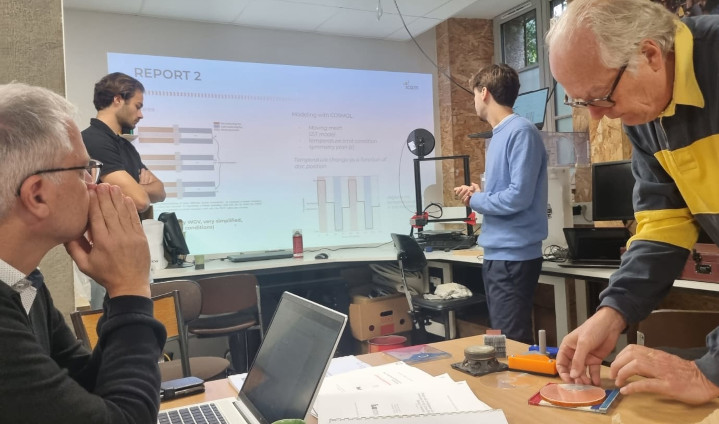
Following the successful proof-of-concept validation of Laboratory Model v3 at Linköping University in 2024,
the Green Revolution Energy Converter project entered an international continuation phase at ICAM (Toulouse)
under the supervision of Michael Peyrony-Rapatout and Pierre Le Provost. The ICAM study extended the Swedish
findings by developing coupled thermal–thermodynamic numerical models aimed at quantifying the converter’s
useful energy output and efficiency under controlled conditions. Two complementary tools were implemented:
an ANSYS transient model representing the Work Generating Volume (WGV) and its hot and cold fin blocks, and
a MATLAB dynamic model reproducing the idealized pV-cycle of a piston–crank mechanism driven by the periodic
heating of the WGV. The coupling of these models enabled parametric evaluation of key variables—frequency,
heat-transfer coefficient (HTC), and thermal gradient (ΔT)—identified in earlier Linköping work as the dominant performance determinants.
Simulations were conducted for operating frequencies between 0.5 Hz and 3 Hz, with hot- and cold-side
temperatures of 150 °C and 10 °C, respectively. The ANSYS model resolved the transient thermal field within
the revolving WGV and quantified spatial HTC gradients as functions of radius and Reynolds number, revealing
that higher revolving frequency enhances convective exchange but shifts the optimal operating point toward
higher HTC values. The MATLAB cycle model, fed with HTC data extracted from ANSYS, predicted a volumetric
power density of approximately 340 W m⁻³ and a theoretical efficiency near 6 % for the reference case, with
mechanical energy consumption for rotation estimated two orders of magnitude lower. These results confirmed
the potential of the GREC concept to achieve performance comparable to compact low-temperature Rankine or
Ericsson-type systems, provided that HTC optimisation can be realised experimentally. Future work defined
by the ICAM team includes incorporating grooved-fin geometries, pipe-based heat-transfer architectures, and
the design of a low-temperature (≤ 200 °C) laboratory prototype, thereby establishing a direct experimental
bridge between the Swedish and French research phases.
Project presentation at nilsinside.com on this link:
SUSTAINABLE REVOLUTION at ICAM Toulouse
ICAM GREC Project Presentation in English on this link:
ICAM GREC Project Presentation in English