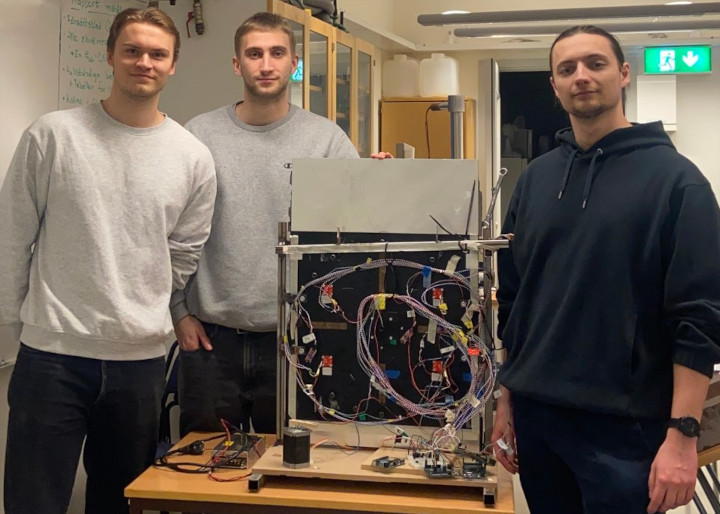
Further development of the Green Revolution Energy Converter
Experimental validation: Erik Widström, Simon
Eriksson, and Richard Zetterman executed systematic experimental
characterisation of the LabModel v3, achieving critical technological
validation milestones that advanced GREC from laboratory demonstration
to empirically-validated proof-of-concept.
- Research Objectives: The investigation addressed
three primary technical challenges: establishing pressure integrity
through systematic leak identification and remediation, implementing
quantitative power output measurement methodologies, and enhancing
operational accessibility through control system refinement and
comprehensive documentation.
- Methodological Innovations: The research team
implemented Raspberry Pi-based control architecture enabling web
interface motor control, systematically identified and sealed pressure
leakage pathways using high-temperature acetoxy silicone sealant capable
of withstanding 250°C, and developed dual power measurement approaches
utilising acoustic transducer conversion (tweeter as linear generator)
and hydrostatic column displacement methods.
- Experimental Validation Results: Comprehensive
testing demonstrated pressure homogeneity throughout
the system volume at operating conditions up to 3 Hz revolving frequency
with a temperature difference of 80 °C between hot and cold fins.
Repeatable pressure oscillations were achieved, with measurements
confirming consistency across multiple test sequences. Power output
characterisation revealed proof-of-concept
functionality, with results enabling extrapolation to larger
geometries, elevated thermal gradients, and increased revolving
velocities.
- Parametric Performance Characterisation: Systematic
investigation established non-linear relationships between operational
parameters: pressure differential increased
exponentially with thermal gradient rather than linearly as
initially hypothesised, while maintaining substantial pressure
oscillations despite doubled and tripled revolving frequencies. Power
output demonstrated linear correlation with internal pressure
differential, validating fundamental thermodynamic predictions.
- Research Significance: This experimental campaign
successfully transitioned GREC technology from computational/analytical
validation to empirical demonstration, establishing repeatability
protocols, quantifying performance metrics, and generating the first
experimental dataset enabling validation of prior theoretical
predictions. The innovative application of acoustic transducers for
mechanical-to-electrical energy conversion, while yielding modest
absolute power levels, validated scaling principles essential for
prototype development. The comprehensive documentation framework
substantially reduces activation energy for subsequent research
initiatives.
Project presentation at nilsinside.com on this link:
https://nilsinside.com/nilsinside/BREC_V2/LiU_part4.html
Project report "Further development of the Green Revolution Energy Converter" on this link:
https://www.nilsinside.com/nilsinside/BREC_V2/TMMT31_01_rapport.pdf