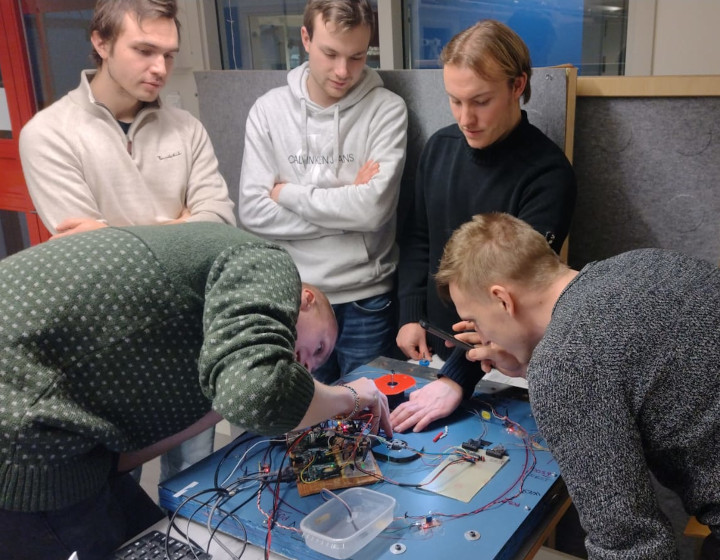
Authors: Gustav Edholm, John Malmdal, Lukas Haglund, Markus Eriksson and Oscar Magnusson.
This team achieved a significant milestone by developing a custom analytical framework to
theoretically validate the GREC technology. Their report established a mathematical model
based on Carnot engine principles, performed material analysis, developed calculation
models in MATLAB, thermal simulations in ANSYS, and CAD geometry in CREO.
To get an overview of how the heat transfer coefficient (HTC) behaved in the model, the
change of airflow was computed along the radius, a mathematical tool for performance
calculations was developed to theoretically verify the technology of the GREC. By
applying a few simplifications and assumptions, the tool provided reasonable results
compared to scientific theory. How different scales affect the performance of the
GREC was examined and results showed that a larger GREC model would be more effective
and able to produce more power at several given source temperatures. The revolving
speed proves to impact the heat transfer capability in the engine, primarily by
affecting the magnitude of the HTC but also the achieved temperature difference in
the Work Generating Volume (WGV). A higher temperature difference between the heat
sources also leads to a significantly higher obtained power output and efficiency,
making it a promising concept to study further.
The research team’s conclusions explicitly acknowledged that “real experiments with similar
operating modes must be conducted and compared” to validate their mathematical framework.
From Theory to Computational Investigations:
The Spring 2022 analytical predictions established testable hypotheses regarding GREC
thermal performance. To validate these computational findings and quantify parametric
dependencies between geometric configurations and system performance, Linköping
University launched two parallel computational investigations in the following
Autumn 2022.
Project presentation at nilsinside.com on this link:
Publication at Linköpings Universitet - Digitala Vetenskapliga Arkivet - Theoretical Proof Of Concept For The Green Revolution Energy Converter
Project report "Theoretical Proof Of Concept For The Green Revolution Energy Converter" on this link:
Theoretical Proof Of Concept For The Green Revolution Energy Converter